Can You Really Use Free SVG Files to Sell on Etsy with a Cricut?
The short answer is yes — but only if you use the right files with the right license.
Thousands of Cricut sellers are generating real income every month selling personalised tumblers, custom t-shirts, tote bags, and home decor items on Etsy. Many of them started with zero design experience and zero budget for graphics. What they had was a Cricut machine, a reliable source of free SVG files to sell on Etsy, and the knowledge to use them legally.
The keyword there is legally. The single biggest mistake new Cricut sellers make is assuming “free to download” means “free to use however you want.” It doesn’t. A free SVG file and a commercially licensed SVG file are two very different things, and confusing them can result in Etsy shop takedowns, legal notices, and refunded orders at your expense.
This guide exists to close that knowledge gap. By the time you finish reading, you’ll know exactly which free SVG files you can use to sell on Etsy with your Cricut, how to vet them, how to price your products, how to set up your shop, and how to build a brand that grows beyond any single design trend.
Used correctly, free SVG files are not a shortcut or a compromise. They are a legitimate and sustainable foundation for a Cricut business — and for sellers who understand licensing, they represent a serious competitive advantage.
Understanding SVG File Licenses Before You Sell a Single Product on Etsy
Before you cut a single piece of vinyl or press a single transfer, you need to understand the licensing landscape. This is not optional reading — it is the difference between a business and a liability.
Every SVG file you download comes with a license, whether it’s written out explicitly or implied by the platform it came from. That license is a legal agreement between you and the creator that defines what you can and cannot do with the file. Ignoring it doesn’t make it go away. It just means you’re violating it unknowingly — and Etsy enforces IP complaints swiftly.
The main license categories you’ll encounter
Personal use only
This is the most common type on free design sites. You can download the file, make things with it for yourself, gift them, or use them around your home. The moment money changes hands — whether you’re selling a finished product, accepting a custom order, or giving it away as part of a business promotion — you’re in violation. These files cannot be used as free SVG files to sell on Etsy.
Commercial use allowed
This is what you need. A commercial use license means the creator has granted permission to use the design in products you sell. However, this is where many sellers stop reading. Commercial use licenses often come with their own restrictions, such as limits on print runs, requirements to credit the designer, restrictions on digital resale, or prohibitions on selling on specific platforms including Etsy. Always read the full terms.
Extended commercial use / small business license
Some creators offer tiered licensing. A standard commercial license might cover up to 500 units sold. An extended license removes that cap. If you’re planning to scale your Cricut Etsy shop, pay attention to unit limits from the outset.
Creative Commons licenses
These are standardised open licenses often used by independent designers. CC0 (public domain) is the most permissive — you can use it for anything. CC BY requires attribution. CC BY-NC restricts commercial use entirely. Know which variant you’re dealing with before you list a single product on Etsy.
Royalty-free
This term is widely misunderstood. Royalty-free does not mean free. It means you pay once (usually a subscription or per-download fee) and don’t owe ongoing royalties. Most royalty-free licenses still prohibit certain commercial applications. Read carefully.
The golden rule: if the license doesn’t explicitly say commercial use is permitted, assume it isn’t — and don’t use it to sell on Etsy.
What ‘Free for Commercial Use’ Actually Means for Cricut Etsy Sellers
Finding a file labelled “free for commercial use” feels like hitting the jackpot. And it can be — but this phrase is used loosely across the internet, and sellers who take it at face value without reading further often run into problems on Etsy.
What it usually covers
- Using the design on physical products you sell (t-shirts, tumblers, tote bags, home decor, etc.)
- Selling those products through Etsy, Amazon Handmade, or your own website
- Using the design across multiple orders without paying per-use royalties
- Making modifications to the design for your products (sizing, colour changes, combining with other elements)
What it often doesn’t cover
- Reselling the SVG file itself as a digital download on Etsy
- Including the file in your own SVG bundle or design pack for sale
- Using the design on print-on-demand platforms (some licenses specifically exclude POD)
- Mass production beyond a stated unit threshold
- Use in products that could be considered competing with the designer’s own products
- Sublicensing — meaning you cannot pass the right to use the file on to another person
The attribution question is worth addressing directly. Some free commercial licenses require you to credit the designer somewhere — on your Etsy listing, your packaging, or your website. Others explicitly waive this requirement. If attribution is required and you don’t provide it, you’re technically in breach of the license even if your products are otherwise legal.
Platform-specific restrictions are increasingly common. Some designers grant commercial use for Etsy but not for Amazon, or for physical products but not digital files. If you plan to sell across multiple platforms, verify that the license covers all of them.
When in doubt, contact the designer directly. Most are happy to clarify, and a brief email exchange creates a paper trail that protects your Etsy shop.
How to Vet Free SVG Files Before Using Them to Sell on Etsy
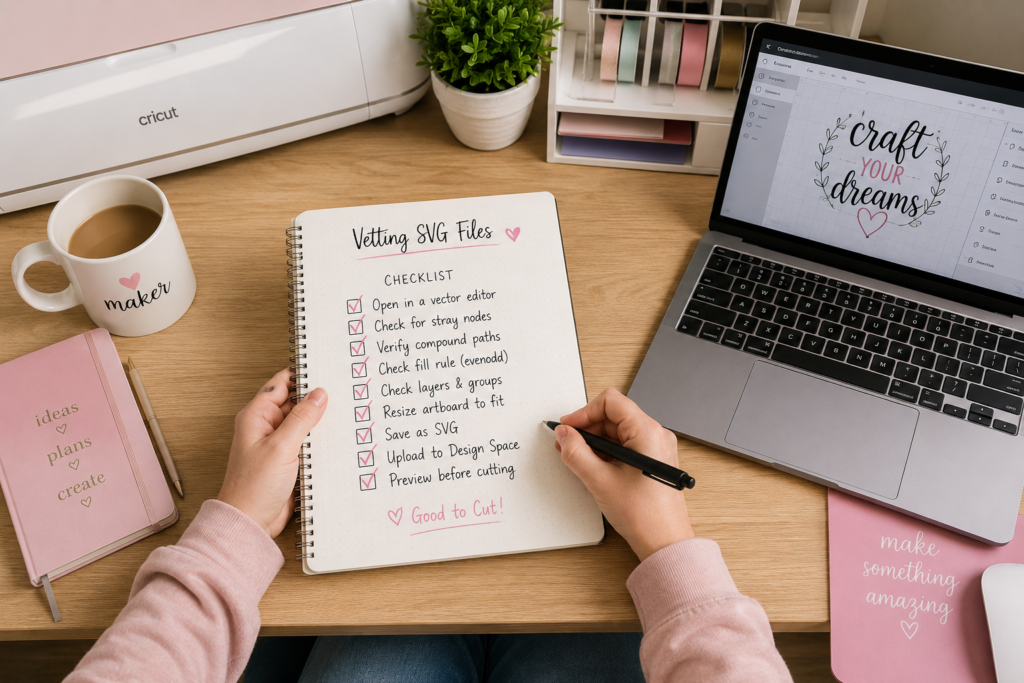
Knowing the rules is one thing. Applying them consistently to every file you download is another. Here is a practical vetting process to run through each time you find a file you want to use in your Cricut Etsy shop.
Step 1: Find the license, not just the label
Don’t rely on a badge or a tag that says “commercial use.” Find the actual license document or terms of use page. On reputable sites, this will be linked clearly on the download page or in the site’s footer. If you can’t find any license information at all, treat the file as personal use only — not as a free SVG file you can sell on Etsy.
Step 2: Check who created it
Free SVG aggregator sites sometimes host files uploaded by users rather than the original designers. This creates a chain of ownership question: does the person who uploaded the file actually have the right to grant you a commercial license? Prefer sites where the creator is identifiable and where the platform verifies upload rights.
Step 3: Reverse image search the design
Run the design through Google Images or TinEye. If the same design appears on a paid stock site like Shutterstock or Creative Market, someone may have ripped it and uploaded it to a free site without the original creator’s permission. Using it on Etsy would expose you to claims from the legitimate rights holder.
Step 4: Read the restrictions, not just the headline
As covered above, “commercial use allowed” is often followed by conditions. Unit limits, platform restrictions, attribution requirements, and digital resale prohibitions are all common. Read the full terms before listing on Etsy, not just the summary.
Step 5: Save your receipts
For every free SVG file you use to sell products on Etsy, keep a record: where you downloaded it, the date, the license terms as they appeared at the time, and a screenshot of the license page. License terms can change. If a designer later restricts a file that was previously open for commercial use, having documentation of the terms at the time of download gives you a defensible position with Etsy.
Step 6: When in doubt, reach out
A quick message to a designer saying “I’d like to use your design on tumblers I sell on Etsy — is your commercial license okay for this?” takes two minutes and eliminates uncertainty. Most designers respond quickly and appreciate the professionalism.
Best Cricut Products to Make and Sell on Etsy Using Free SVG Designs
Not all Cricut products are created equal when it comes to profit margins, production time, and demand on Etsy. If you’re starting with free SVG files to sell on Etsy, these categories offer the best combination of low material cost, strong buyer demand, and design flexibility.
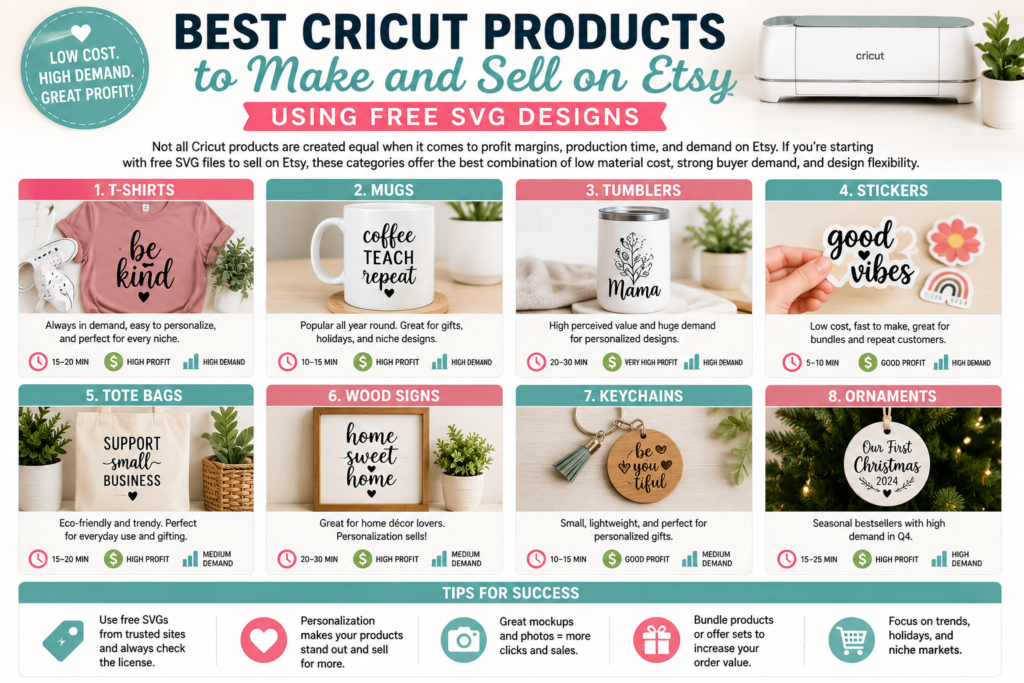
Personalised tumblers and drinkware
The tumbler market is enormous and shows no signs of slowing down. 20oz and 40oz Stanley-style tumblers with vinyl decals or full wraps are consistently top sellers on Etsy. Free SVG files for quotes, floral designs, and monograms work exceptionally well here. Profit margins are strong once you have a reliable material supplier.
Custom t-shirts and apparel
Iron-on vinyl (HTV) applied with a heat press makes apparel one of the most accessible product categories for new Cricut Etsy sellers. Free SVGs with motivational quotes, occupational designs (nurse life, teacher life, dog mum), and seasonal themes drive consistent search volume. Keep a rotation of evergreen designs alongside seasonal drops.
Personalised tote bags
Low material cost, high perceived value, and strong gifting appeal make tote bags a reliable starter product for your Etsy shop. Canvas totes with vinyl designs sell particularly well around Mother’s Day, birthdays, and the back-to-school period.
Home decor and wall art
Vinyl wall decals, wooden signs, and door hangers all perform well on Etsy using free SVG designs. This category allows for higher price points than apparel and benefits from seasonal demand spikes around Christmas, Halloween, and Valentine’s Day.
Stickers and decals
High volume, low materials cost, and fast production time make stickers an excellent product for building Etsy order momentum. Kiss-cut sticker sheets with cohesive design themes sell well and are easy to fulfil.
Gifts and occasion items
Wine glasses, keyrings, ornaments, and gift boxes personalised with free SVG Cricut designs tap into the Etsy gifting market, which is consistently strong year-round. These items also command premium pricing around key gifting occasions.
When selecting your starting category, consider your existing equipment, storage space, and production capacity. Starting with one or two product types and doing them well is more profitable than spreading thin across many.
Setting Up Your Etsy Shop for Cricut Crafts: A Practical Checklist
Etsy remains the primary marketplace for handmade and personalised goods, and for Cricut sellers using free SVG files it offers unmatched buyer intent. Here is a practical setup checklist to get your shop launch-ready.
Before you open
- Choose a shop name that reflects your niche without locking you into a single product category too narrowly
- Research your competitors — look at top sellers in your category, note their photography style, pricing, listing titles, and review patterns
- Prepare at least 10 listings before you launch — shops with more listings rank better in Etsy search from day one
- Set up your payment and billing details and verify your identity with Etsy
Listing optimisation
- Write titles that lead with the most searchable keywords — “Personalised Tumbler Vinyl Decal Cricut Gift” rather than cute but unsearchable names
- Use all 13 tags per listing, mixing broad and specific keyword phrases
- Write descriptions that answer buyer questions: size, materials, production time, personalisation process, care instructions
- Use the attributes section fully — occasion, colour, material, recipient — these feed into Etsy’s filtered search
Photography
- Natural light or a good lightbox is non-negotiable — poor photography kills conversion rates regardless of product quality
- Show the product in use (lifestyle shots) as well as flat lay product shots
- Include scale references so buyers understand size
- Show personalisation options where relevant
Shop policies
- Write clear policies on production time, shipping estimates, returns, and personalisation order process
- Be specific about what happens with incorrect personalisation details submitted by the buyer
After launch
- Run Etsy Ads at a modest budget ($1–3/day) on your best listings to gather click and conversion data early
- Request reviews from every completed order — your review count is a significant trust signal
- Monitor your shop stats weekly to understand which listings are getting impressions and which are converting
How to Price Cricut Products Made from Free SVG Files
Pricing is where many new Cricut Etsy sellers leave significant money on the table. The instinct to price low to attract buyers is understandable but counterproductive. Underpriced products signal low quality, attract bargain hunters who leave difficult reviews, and make your business unsustainable.
Calculate your true cost of goods
- Materials (vinyl, blanks, packaging, transfer tape, ink) — be precise, not approximate
- Consumables (cutting mat wear, blade wear, weeding tools) — amortise these across products
- Your time — at minimum wage if you’re just starting, at your target hourly rate once you’re established
- Platform fees — Etsy charges a listing fee, a transaction fee, and a payment processing fee. Factor all of them in, not just the transaction percentage
- Shipping materials and labour
Apply a sustainable markup
A common rule of thumb is to price at 3–4x your material cost for handmade goods. This is a starting point, not a ceiling. Once you factor in your time, Etsy fees, and desired profit margin, many Cricut products should be priced at 5–6x material cost or higher.
Research the Etsy market
Look at what top-selling Etsy shops in your category charge. Note that the highest-selling shops are rarely the cheapest. They win on photography, reviews, and perceived quality. Price within the range of established sellers, not below the lowest price you can find.
Don’t undervalue personalisation
Personalised orders take additional time and carry additional risk of error. Charge for that. A personalised tumbler should cost meaningfully more than a standard design tumbler. Buyers who want personalisation on Etsy expect and accept premium pricing.
Revisit your pricing regularly
As your material costs change, your production efficiency improves, and your review count grows, your pricing should evolve. Sellers with 500+ five-star Etsy reviews can and should charge more than a new shop with 10 reviews. Don’t set prices once and forget them.
Platforms Beyond Etsy: Where Else to Sell Your Cricut Crafts
Etsy is the obvious starting point for selling Cricut products made with free SVG files, but a resilient business doesn’t depend on a single platform. Algorithm changes, fee increases, and policy shifts are facts of life. Diversification protects your income.
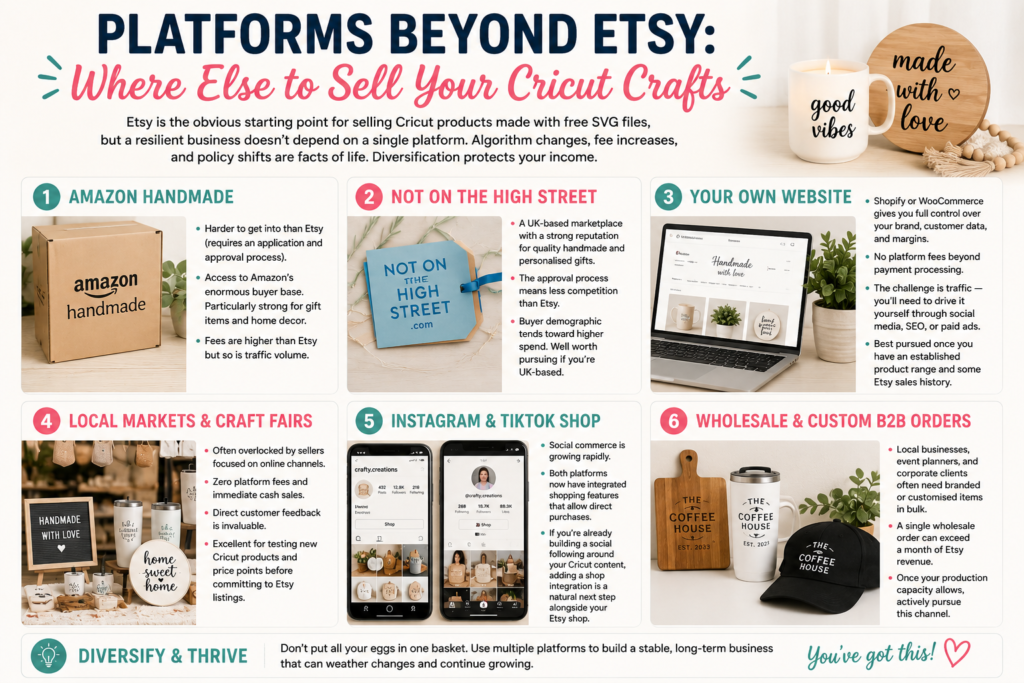
Amazon Handmade
Harder to get into than Etsy (requires an application and approval process) but offers access to Amazon’s enormous buyer base. Particularly strong for gift items and home decor. Fees are higher than Etsy but so is traffic volume.
Not On The High Street
A UK-based marketplace with a strong reputation for quality handmade and personalised gifts. The approval process means less competition than Etsy, and the buyer demographic tends toward higher spend. Well worth pursuing if you’re UK-based.
Your own website
Shopify or a WooCommerce site gives you full control over your brand, customer data, and margins. No platform fees beyond payment processing. The challenge is traffic — you’ll need to drive it yourself through social media, SEO, or paid ads. Best pursued once you have an established product range and some Etsy sales history.
Local markets and craft fairs
Often overlooked by sellers focused on online channels, local markets offer zero platform fees, immediate cash sales, and direct customer feedback. They’re also excellent for testing new Cricut products and price points before committing to Etsy listings.
Instagram and TikTok Shop
Social commerce is growing rapidly. Both platforms now have integrated shopping features that allow direct purchases. If you’re already building a social following around your Cricut content, adding a shop integration is a natural next step alongside your Etsy shop.
Wholesale and custom B2B orders
Local businesses, event planners, and corporate clients often need branded or customised items in bulk. A single wholesale order can exceed a month of Etsy revenue. Once your production capacity allows, actively pursue this channel.
Building a Sustainable Cricut Brand Around Free SVG Resources
Sellers who build brands outlast sellers who just list products. The difference is not design talent or budget — it’s intentionality about how you use your free SVG files to build something bigger than any single Etsy listing.
Choose a niche within a niche
“Cricut crafts” is not a brand. “Personalised gifts for dog mums” is. “Modern farmhouse home decor in neutral tones” is. “Funny teacher appreciation gifts” is. The narrower your focus, the stronger your brand recognition and the more targeted your Etsy buyer base. You can always expand once you’ve established authority in a specific area.
Develop a consistent visual identity
Your product photography, packaging, listing thumbnails, and social media should all feel like they come from the same place. This doesn’t require a professional designer — consistent backgrounds, lighting, and colour palette are enough to create coherence across your Etsy shop.
Packaging is part of the product
Tissue paper, branded stickers on packaging, a small thank-you card, a care instruction card — these cost pennies and dramatically increase the likelihood of positive Etsy reviews and repeat purchases. Buyers who feel their order was packaged with care become repeat customers and enthusiastic reviewers.
Build a content strategy around your audience’s questions
A blog, YouTube channel, or TikTok account that answers the questions your buyers are asking — gift ideas for teachers, how to care for vinyl decals, what to put on a personalised tumbler — builds organic traffic and brand authority over time. It also drives buyers back to your Etsy shop consistently.
Common Legal Mistakes New Cricut Etsy Sellers Make (And How to Avoid Them)
The Cricut selling community is full of cautionary tales about Etsy shop suspensions and legal notices. These are the most common errors and how to sidestep them entirely.
Using Disney, Marvel, or other character designs
This is the number one mistake new sellers make. Character designs, logos, and branded imagery from major entertainment companies are aggressively protected intellectual property. It doesn’t matter that you found the SVG for free online. Etsy regularly removes listings and suspends shops for IP violations, and the companies themselves send legal notices to individual sellers. This risk is simply not worth taking when there is an abundance of legally safe free SVG files to sell on Etsy.
Assuming fan art is always acceptable
Fan art occupies a legal grey area that many sellers misunderstand. Creating fan art is generally tolerated by rights holders — selling it commercially on Etsy is a different matter entirely. Some companies explicitly prohibit commercial fan art. Others tolerate it until they don’t. Building a business on fan art of any IP you don’t own is building on sand.
Not keeping license records
If Etsy receives a takedown notice on one of your listings and asks you to prove you have the right to use a design, you need documentation. A screenshot of the license terms at the time of download takes thirty seconds to save and could save your shop.
Buying SVG bundles from questionable sources
Cheap SVG bundles on low-quality marketplaces or certain Facebook groups frequently contain designs stolen from original creators and relicensed without authority. The person selling the bundle has no right to grant you a commercial license because they don’t own the designs. Use reputable sources with verifiable ownership when sourcing free SVG files to sell on Etsy.
Ignoring trademark searches
A phrase that seems generic might be trademarked. Before building an Etsy product line around a phrase, run a quick trademark search through the relevant national registry (the UK Intellectual Property Office, or USPTO in the US).
Selling the SVG files themselves
Unless the commercial license you hold explicitly permits digital resale, you cannot sell or redistribute the SVG files on Etsy. You can sell the physical products you make from them. The files themselves remain the property of the original creator.
Where to Find Free SVG Files to Sell on Etsy with Your Cricut
The quality of your free SVG source matters as much as the quality of the designs themselves. Not all free SVG sites are created equal when it comes to commercial licensing clarity, design quality, and file organisation for Cricut sellers.
When evaluating where to find free SVG files to sell on Etsy, look for these qualities in a source:
- Explicit commercial licensing — the site should clearly state that files are available for commercial use, not leave it ambiguous
- No attribution required — for a professional Etsy seller, having to credit a design source on every listing is friction. Sites that waive attribution for commercial users offer a cleaner business experience
- Design quality and Cricut compatibility — clean, well-constructed SVG files that import cleanly into Cricut Design Space without requiring significant repair work
- Regular updates — a site that adds new designs regularly lets you respond to Etsy trends and seasonal demand without scrambling for sources
- Organised by niche and product type — files organised by product category (tumblers, apparel, home decor, seasonal) rather than undifferentiated categories
- Verifiable creator ownership — prefer sites where the creator is identifiable and the platform verifies upload rights
The sites that meet all of these criteria consistently tend to be those built specifically with Cricut sellers and small business owners in mind, rather than general hobbyist download repositories. Prioritise sources that speak directly to the needs of Etsy entrepreneurs — not just crafters.
Frequently Asked Questions: Free SVG Files, Cricut, and Selling on Etsy
Can I sell products made with Cricut Design Space’s built-in images?
Cricut’s Access subscription includes images that are licensed for personal use. Some images are available for commercial use under Cricut’s commercial licensing terms, but you must verify this for each individual image within Design Space before listing on Etsy. Look for the commercial use indicator on each asset.
Do I need to register a business to sell Cricut crafts on Etsy?
In most jurisdictions, you can begin selling on Etsy as a sole trader without formal business registration. However, as your income grows you’ll want to address your tax obligations, consider business registration for liability protection, and potentially register for VAT or sales tax depending on your location and volume.
Can I modify a free SVG before selling products made from it on Etsy?
Usually yes, but check the license. Most commercial use licenses permit modifications including resizing, colour changes, and combining with other design elements. What’s almost universally prohibited is claiming the original design as your own creation.
What if someone claims I’m selling their design without permission on Etsy?
Respond promptly, professionally, and with your documentation. If you have clear records showing you used a legitimately licensed free SVG file, state this and provide the evidence. If the claim is valid and you made an error, remove the Etsy listings immediately, take responsibility, and learn from it.
How many products should I have before opening my Etsy shop?
Aim for at least 10 listings. Etsy’s search algorithm gives more visibility to shops with more listings, and a fuller shop signals legitimacy and commitment to browsing buyers. Having 20–30 listings at launch gives you a much stronger foundation than opening with two or three.
Is it worth paying for SVG files versus using free ones to sell on Etsy?
For specific design styles not available in free commercial-use libraries, paid files can be worthwhile. But many sellers operate highly profitable Etsy businesses using only free commercially licensed SVGs. The license matters far more than the price point. A free SVG file with clear commercial licensing is always preferable to a paid SVG with ambiguous terms.
Start Selling on Etsy with Free Cricut SVG Files Today
The path from “I have a Cricut machine” to “I have a profitable Etsy shop” is shorter than most people think. What it requires is not a large budget, advanced design skills, or an enormous product range. It requires the right foundations: legally sound free SVG files, a clear understanding of your Etsy market, disciplined pricing, and consistent execution.
Free SVG files to sell on Etsy with your Cricut — the right ones, from the right sources, used within the right license terms — are a genuine business asset. They give you the flexibility to launch new products quickly, respond to seasonal demand, test designs without financial risk, and maintain margins that make your Etsy business worth running.
Download this file then check it's Cricut-ready with SVG Doctor before you cut — it scans for stray nodes, layer issues, and anything that might cause problems in Design Space.
Check My SVG Free →